
Shopify Plus Migration Guide: Timeline, Cost & Risk Checklist
By:
Plan a safer Shopify Plus migration with timeline checkpoints, SEO risks, data validation, launch QA, and post-launch conversion measurement.
How do enterprise brands migrate from Magento to Shopify Plus without losing SEO equity or breaking critical ERP integrations? Scaling with Shopify Plus requires transitioning from Magento's heavy, self-hosted EAV database to a decoupled, API-first SaaS architecture. By systematically mapping database schemas, implementing a zero-loss redirect strategy, and rebuilding synchronous integrations as asynchronous event-driven flows, our team eliminates technical debt while preserving search rankings.
Key Takeaways
- The EAV-to-Metafield Protocol: Map Magento's complex Entity-Attribute-Value tables to Shopify Metafields and Metaobjects via the GraphQL Admin API.
- The Zero-Loss Redirect Map: Prevent organic traffic drops by executing a 1:1 redirect mapping of legacy .html URLs to Shopify's structured paths.
- Asynchronous Integration Architecture: Replace synchronous PHP-based ERP/CRM calls with event-driven Shopify Webhooks routed through AWS EventBridge.
- TCO Reduction: Eliminate unpredictable hosting and maintenance fees, shifting to a predictable SaaS model with native security and speed.
Database Mapping: Translating Magento EAV Architecture to Shopify Plus Metafields
Scaling with Shopify Plus requires mapping Magento’s complex Entity-Attribute-Value (EAV) database model to Shopify’s streamlined architecture. Entity-Attribute-Value (EAV) is a data model used by Magento to store product attributes in separate tables, allowing for highly flexible but query-intensive database structures. While Magento spreads product data across dozens of database tables, Shopify Plus uses structured Metafields and Metaobjects to store custom attributes, preserving complex product relationships and technical specifications without performance degradation.
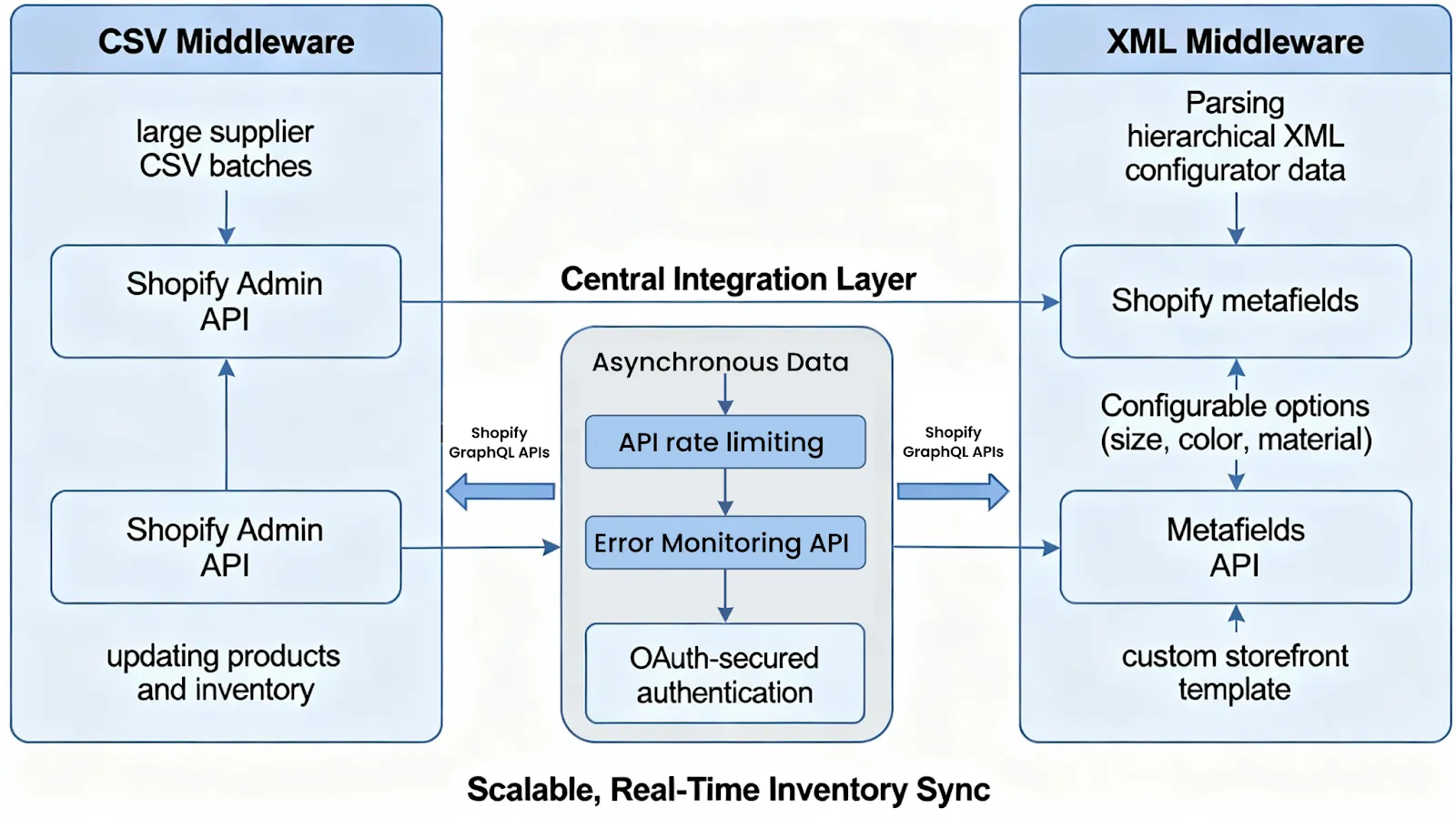
Implementation: Mapping Step-by-Step
- Extract Magento EAV Attributes: Query the
eav_attributeandcatalog_product_entitytables to isolate custom attributes like dimensions, materials, or supplier codes. - Define Shopify Metafield Definitions: Create matching Metafield definitions in Shopify Admin using matching data types (e.g., single_line_text_field, json, or number).
- Leverage Metaobjects for Relational Data: Use Metaobjects to handle multi-field complex structures, such as store locations or warranty terms, that previously required custom Magento tables.
- Automate the Import: Use custom Shopify development to programmatically map legacy fields via the GraphQL Admin API, bypassing manual CSV upload limits.
Preserving SEO Equity: Redirect Mapping for Complex Magento URL Structures
Magento allows highly customized, deeply nested URL paths ending in .html. Shopify Plus enforces a strict structure: /products/product-handle and /collections/collection-handle.
Failing to map these routes correctly will trigger 404 errors, destroying years of search rankings and organic traffic.
The Zero-Loss Redirect Map Checklist
- Crawl the Live Magento Site: Run a full crawl using Screaming Frog to capture all indexable URLs, canonicals, and metadata.
- Export Search Console Data: Download the last 12 months of high-traffic landing pages from Google Search Console to ensure no active URLs are missed.
- Map Legacy URLs to Shopify Paths: Create a 1:1 redirect map matching old Magento paths to the new Shopify URL structure.
- Configure 301 Redirects: Upload the mapping directly to Shopify's native URL redirect engine using CSV imports or a specialized redirect app.
- Validate Post-Launch: Run a post-migration crawl immediately after DNS switchover to confirm all redirects return a 301 status and resolve to the correct 200 OK pages.
To ensure your organic search visibility remains intact during this transition, consider leveraging dedicated Shopify SEO services to oversee the technical redirect strategy.
Rebuilding Custom Magento ERP and CRM Integrations via Shopify Plus Admin APIs
Magento integrations rely on heavy, synchronous PHP code. Shopify Plus requires a decoupled, asynchronous approach powered by REST and GraphQL Admin APIs.
What to Avoid: Common Integration Mistakes
- Replicating Synchronous Calls: Do not design integrations that write directly to Shopify in real-time during checkout; this triggers API rate limits.
- Hardcoding Credentials: Avoid hardcoding API keys in theme files; always use Shopify custom apps with secure environment variables.
- Ignoring Webhook Retries: Do not assume webhooks always deliver on the first attempt; build an idempotency key verification system to prevent duplicate orders.
How to Build Resilient Integrations
- Use Webhooks for Event-Driven Flows: Trigger ERP updates asynchronously using Shopify Webhooks (e.g.,
orders/create) routed through AWS EventBridge. - Implement GraphQL Bulk Operations: For massive inventory updates, use Shopify's Bulk Import API instead of individual REST calls to prevent rate limiting.
- Queue API Requests: Build a middleware layer (using Node.js or Python) with a queuing system to throttle API requests and handle 429 Too Many Requests responses gracefully.
Magento vs. Shopify Plus: Total Cost of Ownership (TCO) Comparison
Magento is often perceived as "free" open-source software, but its total cost of ownership (TCO) is significantly higher than Shopify Plus for enterprise brands. Below is a comparison of typical costs for an enterprise store processing $10M+ annually:
Expense Category Magento (Self-Hosted) Shopify Plus (SaaS) Hosting & Infrastructure $3,000 - $10,000+ / month (AWS/Azure) Included in platform fees Security & Maintenance 40 - 80 hours / month (patches, upgrades) Natively managed by Shopify Core Platform Fees $0 (Open Source) or high licensing fees Starts at $2,000 / monthBy moving infrastructure management to a SaaS model, brands also benefit from built-in speed improvements. Implementing a Shopify speed optimization strategy becomes much simpler without server-side bottlenecks.
Selecting the Right Partner: Vetting a Magento Web Development Agency vs. a Shopify Plus Migration Consultant
A traditional Magento web development agency is optimized for server management, database tuning, and custom PHP module development. A Shopify Plus migration consultant specializes in API integrations, SaaS ecosystem architecture, and front-end performance.
- Assess API Expertise: Ask candidates to explain how they handle Shopify's GraphQL rate limits and bulk import APIs.
- Review Migration Portfolio: Look for documented case studies showing successful migrations of $10M+ GMV brands from Magento to Shopify Plus.
- Evaluate Ecosystem Knowledge: Ensure the partner understands how to replace Magento modules with native Shopify features or third-party SaaS apps.
How Avelize Approaches Enterprise Migrations
Our team executes Magento-to-Shopify migrations with a structured, four-phase process designed to mitigate risk and ensure zero data loss:
- Discovery & Architecture Mapping (Weeks 1-3): We align your legacy database schema with Shopify's native architecture. KPI: 100% database schema alignment.
- Database Migration & API Integration (Weeks 4-8): We programmatically transfer products, customers, and historical order data. KPI: Zero-loss data transfer.
- Theme Development & SEO Redirect Implementation (Weeks 9-12): We build high-performance front-ends and implement the zero-loss redirect map. KPI: Retain 95%+ search visibility post-launch.
- UAT & DNS Cutover (Week 13): Comprehensive end-to-end testing followed by a seamless launch. KPI: Under 5 minutes of maintenance window.
Frequently Asked Questions
What is the difference between Magento EAV and Shopify Plus database architecture?
Magento relies on an Entity-Attribute-Value (EAV) database model, which distributes product data across multiple tables (such as catalog_product_entity_varchar and catalog_product_entity_int) to allow for highly flexible, custom attributes. While powerful, this architecture requires complex SQL joins that can degrade site performance under heavy traffic loads. In contrast, Shopify Plus utilizes a streamlined, flat database architecture where core product data is stored in a single table, and custom attributes are handled via structured Metafields and Metaobjects. To migrate successfully, enterprise merchants must map legacy EAV attributes to Shopify's GraphQL-accessible Metafield definitions. This structural shift eliminates database bottlenecks, improves page load speeds, and simplifies API integrations. By transitioning to Shopify's SaaS model, merchants trade Magento's high-maintenance database tuning for a fully managed, globally distributed infrastructure that scales automatically during peak traffic events like BFCM without requiring manual server scaling.
How long does a Magento to Shopify Plus migration take?
A typical enterprise migration takes between 12 to 16 weeks, depending on the complexity of legacy ERP integrations, database size, and custom front-end requirements.
Will migrating to Shopify Plus affect our SEO rankings?
If executed with a precise 1:1 redirect map, SEO impact is minimal. Our zero-loss redirect strategy ensures all legacy Magento URLs are mapped to their new Shopify equivalents, preserving search equity and domain authority.
Ready to scale your enterprise store without the overhead of legacy infrastructure? Contact our team of Shopify Plus migration consultants to schedule a technical architecture review.
Published / Last reviewed: November 2026.
Shopify Plus Migration Risk Checklist
A Shopify Plus migration should be planned around risk, not only around launch tasks. The most important work is deciding which URLs, templates, analytics events, redirects, integrations, and checkout flows must survive the move without damaging revenue or organic search visibility.
- Map current revenue-driving URLs and search queries before changing templates.
- Validate redirects, canonicals, structured data, and sitemap output before launch.
- Test checkout, payments, analytics, consent, and third-party scripts in a staging flow.
- Measure Core Web Vitals, conversion rate, crawl errors, and revenue after launch.
Phased Shopify Plus Implementation Plan
For many teams, a phased migration is safer than changing every business-critical system at once. Start with the pages and flows that create the highest revenue or SEO risk, then move into secondary templates, automation, and experimentation after the foundation is stable.
Authoritative References
Use these official resources to verify platform-specific claims and implementation details before making commercial or technical decisions.
Related Avelize Services: Services · Ecommerce Web Design Agency